




Goats are often described as low-maintenance animals, and compared to cattle or pigs, that reputation has some truth to it. They browse widely, tolerate harsh conditions, and convert fibrous plants into meat and milk. But low-maintenance does not mean low-input. Anyone who has kept goats through a dry season or raised kids to market weight knows that feed is where the real challenge sits.
The problem is not simply having enough feed. It is having the right feed, in the right form, available at the right time. Goats are selective eaters. They will sort through a mixed ration and leave behind the parts they dislike, which are often the mineral and protein components that matter most. They waste feed by pulling it out of troughs and trampling it. And their nutritional needs shift quickly with age, pregnancy, and lactation.
Across Africa, Latin America, and parts of Asia, small ruminant farming supports millions of households. These operations rarely have access to cheap, consistent commercial feed. They rely on crop residues, browse, and whatever grain or by-product is available locally. The question is how to turn those scattered resources into a reliable ration without spending more than the animals are worth.
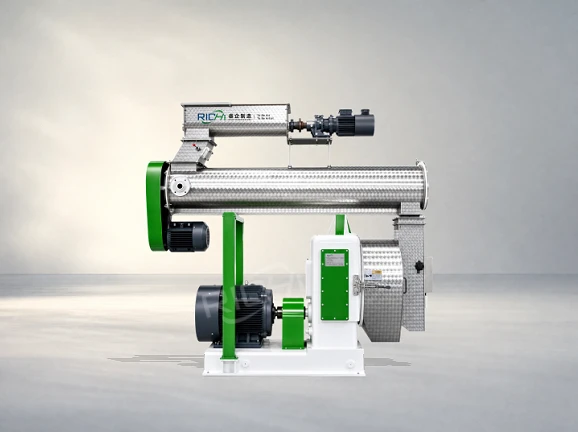
That is the practical role of a goat feed machine. It gives farmers a way to process local ingredients into a uniform feed that goats cannot easily sort, and that stores and handles better than loose meal. But the equipment is only one part of a larger decision about feed sourcing, formulation, labor, and cost.
This article looks at goat nutrition from a practical angle. It covers why goats are difficult to feed well, what ingredients work in smallholder settings, how processing changes feed value, and what farmers and project planners should consider before investing in equipment.
Why Goats Are Harder to Feed Than They Look
Goats are browsers by nature. They prefer leaves, shrubs, and weeds over grass, and they will travel considerable distances to find variety. In a free-range system, they balance their own diet to a surprising degree. Once you confine them, that balance becomes your responsibility.
The first problem is selectivity. Goats have sensitive lips and a strong preference for certain textures and tastes. In a loose mixed ration, they will pick out grain and leave fibrous or mineral-rich particles behind. This sorting behavior means that the ration you formulate on paper is not the ration they actually consume. Over time, that gap shows up as mineral deficiencies or uneven growth.
The second problem is waste. Goats are messy eaters. They pull feed from troughs, drop it on the ground, and refuse to eat what has been stepped on. With loose meal, losses of 10 to 20 percent are common. That is feed you paid for and did not use.
The third problem is seasonality. In many goat-producing regions, feed availability swings dramatically between wet and dry seasons. During the dry season, crop residues and browse decline in quality. Protein content drops, fiber becomes tougher, and animals lose condition. Without a way to store and process feed, farmers are forced to sell animals early or accept poor growth.
The fourth problem is nutrient density. Goats need a diet balanced for energy, protein, minerals, and fiber. Crop residues alone rarely provide that balance. Supplementation is necessary, but supplements are expensive and difficult to distribute evenly in a loose mix.
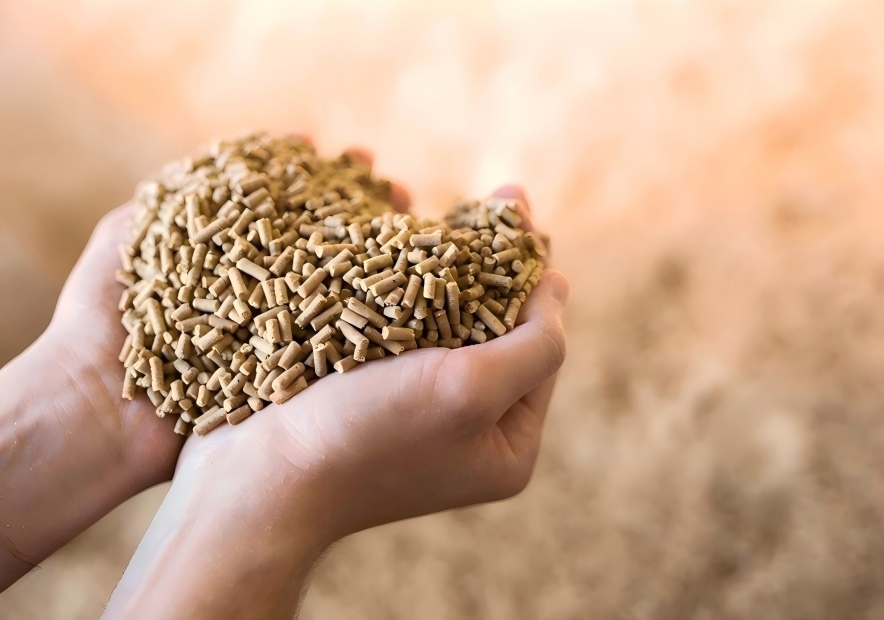
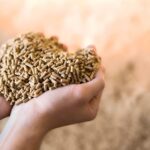
Processing feed into pellets addresses several of these problems at once. Pellets lock the ration into a uniform form. Goats cannot sort them. Waste drops. Storage becomes easier. And because the pelleting process involves heat and pressure, some ingredients become more digestible than they would be in raw form.
What Pelleting Does to Feed Quality
Pelleting is more than grinding and shaping. The process exposes feed to moisture, heat, and pressure as it passes through the die. Starch gelatinizes partially, which makes it easier for digestive enzymes to act. Fiber structure softens. The result is a feed that is often more digestible than the same ingredients fed loose.
There is also a hygiene benefit. The heat generated during pelleting reduces microbial load. In warm, humid climates where feed spoils quickly, this matters. Pellets store longer than meal and are less prone to mold if kept dry.
Handling improves as well. Pellets flow, which makes them easier to bag, transport, and feed out. For farmers working with limited labor, that convenience is not trivial. It reduces the time spent on feeding and the losses that come with manual handling.
The trade-off is cost. Pelleting requires equipment, power, and maintenance. It also requires enough volume to justify the investment. A farmer with ten goats does not need a pellet machine. A cooperative, a commercial farm, or a project supplying many households may find that the economics work.
Matching Equipment to Real Farm Conditions
Equipment selection in small ruminant farming is often driven by assumptions made in Europe or North America, where power is reliable and ingredients are standardized. Conditions in Africa, South Asia, and parts of Latin America are different. A machine that performs well in a temperate climate may struggle in a hot, dusty environment with unstable electricity.
Power supply is the first constraint. Many rural areas have single-phase electricity or frequent outages. Diesel-driven pellet mills offer independence from the grid but cost more to run. Solar-assisted systems are emerging but remain limited in capacity. Buyers need to match the machine to the power actually available, not the power they wish they had.
Ingredient variability is the second constraint. A pellet mill designed for corn and soybean meal may not perform well with high-fiber residues, cassava peels, or molasses-heavy mixes. Die selection matters enormously. A die with the wrong compression ratio will produce soft, crumbly pellets or overheat the machine.
Moisture control is the third constraint. In humid climates, ingredients may be too wet for efficient pelleting. In arid regions, they may be too dry to bind. Both problems require adjustments, and farmers need to understand how to make them.
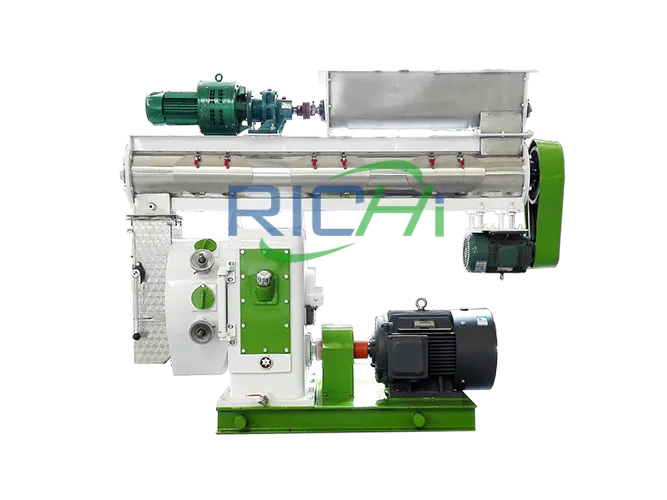
The goat feed machine for farms in Africa category covers a range of equipment sizes and configurations. Some units are small enough for a village cooperative. Others are built for commercial farms producing several tons per day. The right choice depends on the volume needed, the power available, and the ingredients on hand.
It also depends on support. Equipment that cannot be repaired locally becomes a liability. Buyers should consider whether spare parts, dies, and technical advice are available in the region. A slightly more expensive machine with good support is usually a better investment than a cheap machine with none.
Ingredients That Work in Smallholder Systems
Goat rations in smallholder systems are built from what is available, not from what a textbook recommends. That reality shapes formulation. A practical pelleted ration might include:
- Crop residues such as maize stover, sorghum stalks, or rice straw, ground and included for fiber
- Legume forage such as alfalfa, leucaena, or groundnut haulms for protein
- Energy sources such as maize, sorghum, millet, or cassava chips
- Protein supplements such as soybean meal, cottonseed cake, or sunflower cake where available
- Agro-industrial by-products such as molasses, brewer’s grains, or fruit pulp
- Mineral supplements such as limestone, bone meal, or commercial premixes
- Salt for palatability and mineral balance
The goal is not to replicate a commercial formula exactly. It is to build a ration that meets the animals’ needs using what the farm or local market can supply reliably. That means flexibility. A formula that works in one season may need adjustment in another.
Forage inclusion is important for rumen health. Goats need fiber, and a ration that is too concentrated can cause digestive problems. Many practical goat pellets include 30 to 50 percent forage material. The exact proportion depends on the class of animal and the quality of the forage available.
Urea can be used in limited amounts as a non-protein nitrogen source for ruminants, but it requires careful handling and expert guidance. Mistakes can be toxic. For most smallholder operations, it is better to rely on natural protein sources unless technical support is available.
The Cost Question in Small Ruminant Farming
Feed is the largest recurring cost in goat production, just as it is in other livestock systems. For smallholders, the calculation is different from that of commercial farms. Cash is scarce, and labor is often the family’s own. The question is not just whether pelleting saves money, but whether it saves cash.
Buying commercial goat pellets is expensive and often unavailable in rural areas. Mixing feed by hand is cheap in cash terms but costly in labor and waste. On-farm pelleting sits between these options. It requires an upfront investment and some operating cost, but it can reduce waste, improve feed conversion, and allow the use of cheaper local ingredients.
The economics improve when:
- The farm has enough animals to justify regular production
- Local ingredients are available at low cost
- Commercial feed is expensive or unreliable
- Labor is available to run and maintain the equipment
- There is potential to sell surplus pellets to neighbors
- The operation can share equipment across a cooperative or group
The economics are weaker when:
- Flock size is small and feed volume is low
- Ingredients must be purchased at market prices
- Power is unreliable or expensive
- No one is available to maintain the equipment
- Storage for ingredients and finished feed is inadequate
These are practical thresholds, not fixed rules. A cooperative of twenty households may justify a machine that no single household could afford. A commercial farm supplying urban markets may justify a larger machine on volume alone.
Planning a Feed Production System
A pellet machine does not work in isolation. It is part of a system that includes sourcing, storage, grinding, mixing, pelleting, cooling, and feeding. Each step affects the others.
Sourcing comes first. Farmers need reliable access to ingredients at predictable prices. That may mean growing specific crops, contracting with neighbors, or buying from local processors. Without a stable supply, the machine sits idle.
Storage is next. Ingredients need protection from moisture, pests, and spoilage. In humid climates, this is a serious challenge. A simple raised, ventilated shed with proper drainage can make a large difference.
Grinding follows. A hammer mill reduces ingredients to a consistent particle size. Particle size affects pellet quality, digestibility, and energy consumption. Too coarse, and the pellets will not hold together. Too fine, and the machine may clog or consume excess power.
Mixing comes next. Uniformity matters because goats cannot sort pellets, but they can sort poorly mixed meal. A horizontal or vertical mixer blends ingredients into a consistent mass. For small operations, manual mixing may be adequate, but it is labor-intensive and less consistent.
Pelleting is the core step. The machine must be matched to the ingredients, the volume, and the power supply. Die selection, moisture control, and roller adjustment all affect performance.
Cooling follows. Fresh pellets are hot and moist. If they are bagged immediately, condensation leads to mold. Air-drying or a simple counterflow cooler resolves this.
Feeding is the final step. Pellets should be offered in clean troughs with enough space for all animals to eat without competition. Even with pellets, some waste occurs, but it is far less than with loose meal.
Maintenance and Practical Support
Equipment that is not maintained will not last. Pellet mills have wearing parts, especially dies and rollers. In dusty environments, bearings and belts need regular attention. Farmers need to know how to recognize problems early and how to fix them.
The most common issue is die wear. As the die wears, pellet quality drops and power consumption rises. Replacing the die at the right time keeps the machine efficient. Running a worn die too long wastes energy and produces inferior feed.
Roller adjustment is also important. The gap between roller and die determines how effectively material is pressed through. Too loose, and the machine will not form good pellets. Too tight, and wear accelerates.
Lubrication and cleaning are basic but essential. Dust accumulation causes overheating. Moisture causes rust. A regular maintenance routine prevents most problems.
Spare parts availability is a deciding factor in many regions. A machine that cannot be repaired locally is a machine that will eventually sit idle. Buyers should ask about die and roller availability before purchase, not after.
Richi Pellet Mill is one manufacturer that supplies pellet production equipment for agricultural applications, including small ruminant feed. For project planners and commercial farms comparing options, reviewing the manufacturer’s equipment range and support approach is a reasonable part of the decision process.
What Changes When Feed Improves
When goats receive a consistent, balanced, pelleted ration, several things change. Growth rates become more predictable. Kids reach market weight faster. Does maintain condition through lactation. Mortality among young animals drops.
These changes matter economically. A goat that reaches market weight a month earlier costs less to feed and can be sold sooner. A doe that produces more milk raises healthier kids. A flock with lower mortality has more animals to sell.
There are also labor benefits. Pellets are easier to feed than loose meal. They can be measured and distributed quickly. Cleanup is simpler. For households where women and children handle much of the animal care, this reduction in labor is significant.
Environmental benefits are harder to quantify but real. Pelleting allows the use of crop residues and by-products that would otherwise be wasted or burned. It reduces the pressure on grazing land. It can improve soil health if manure is returned to fields.
Common Mistakes to Avoid
Several mistakes come up repeatedly when farmers and projects adopt pelleting.
The first is buying a machine that is too large or too small. Oversized machines waste power and wear out from intermittent use. Undersized machines cannot keep up with demand and become a bottleneck.
The second is ignoring power requirements. A machine that needs three-phase power will not run on a single-phase line without modification. Buyers should confirm the power supply before purchase.
The third is poor die selection. Different ingredients require different die configurations. Using the wrong die leads to poor pellet quality, high energy consumption, and frequent breakdowns.
The fourth is inadequate training. Operators need to understand moisture control, die adjustment, and maintenance. Without training, even good equipment underperforms.
The fifth is neglecting storage. Pellets that are stored in damp conditions will mold, regardless of how well they were made. Storage is part of the system, not an afterthought.
The Broader Context
Small ruminant farming supports food security and livelihoods in many regions. Improving feed efficiency is one of the most direct ways to strengthen that role. It reduces the cost of production, increases the value of animals, and makes better use of local resources.
Pelleting is not a universal solution. It requires investment, skills, and reliable inputs. But where those conditions exist, it can transform a subsistence activity into a more stable and profitable enterprise.
The key is to approach it as a system, not a purchase. Match the equipment to the farm. Match the formulation to the animals. Match the workflow to the labor available. And plan for maintenance and support from the beginning.
Goats are resilient animals. They can survive on poor feed. But surviving is not the same as thriving. A farmer who feeds them well gets more meat, more milk, and more income from the same land and labor. That is the real argument for better feed processing.